Review: The Timeless Journey of a Scroll: ‘The Journey of a Legendary Landscape Painting’ Shines at the Dolby Theatre
By Richard Ren | Los Angeles-based Arts Critic & Freelance Writer
Despite having tickets to the star-studded KCON LA 2025 concert—complete with K-pop idols and Song Seung-heon himself—I found myself drawn to a very different kind of spectacle on August 1. And I wasn’t alone.
Chinese actress Zhang Jingchu, widely known for her discipline and near-total avoidance of social events and entertainment outings in Los Angeles, made a rare exception. She drove herself, solo, across town in Friday rush-hour traffic to the Dolby Theatre in Hollywood to witness the North American premiere of The Journey of a Legendary Landscape Painting, presented by the China Oriental Performing Arts Group.
That alone was reason enough for me to leave the red carpet at the KCON convention center and head straight to the theater. I wanted to see: How good could a dance drama be to merit this kind of praise? And what was drawing such admiration from both Chinese and international audiences?
What unfolded on stage surpassed expectations—and redefined my understanding of what a dance production can accomplish.
Inspired by A Thousand Li of Rivers and Mountains, the legendary 12-meter-long painting by Northern Song Dynasty prodigy Wang Ximeng, the show transports the audience across a thousand years in a lyrical, time-bending narrative. A modern-day museum curator—a “scroll unroller”—finds himself drawn into the past, where he observes the genius of Wang at work, from the first stroke to the final flourish.
The set design is nothing short of exquisite: a rotating stage divides yet connects ancient and modern worlds. Curved panels rise and fall like calligraphic brushstrokes, while the poetic interplay of rain, snow, and shifting light dazzles the senses. The visual language is minimalist yet full of imaginative depth.
Young dancers like Meng Qingyang, Xie Suhao, and Wang Xiaoxuan delivered technically masterful, emotionally stirring performances. Each gesture was precise yet flowing—imbued with meaning that transcended cultural boundaries. From silk weaving to stone grinding, brush making to pigment mixing, the show pays tribute not only to the painting itself, but to the generations of artisans and creators who made such beauty possible.
The visual motif of “qinglü” (blue-green) saturates the production—echoing the mineral pigments of the original scroll and symbolizing the timeless essence of Chinese artistic heritage.
One suggestion for future international performances: more prominent multilingual surtitles would help non-Chinese-speaking audiences connect more deeply with the narrative.
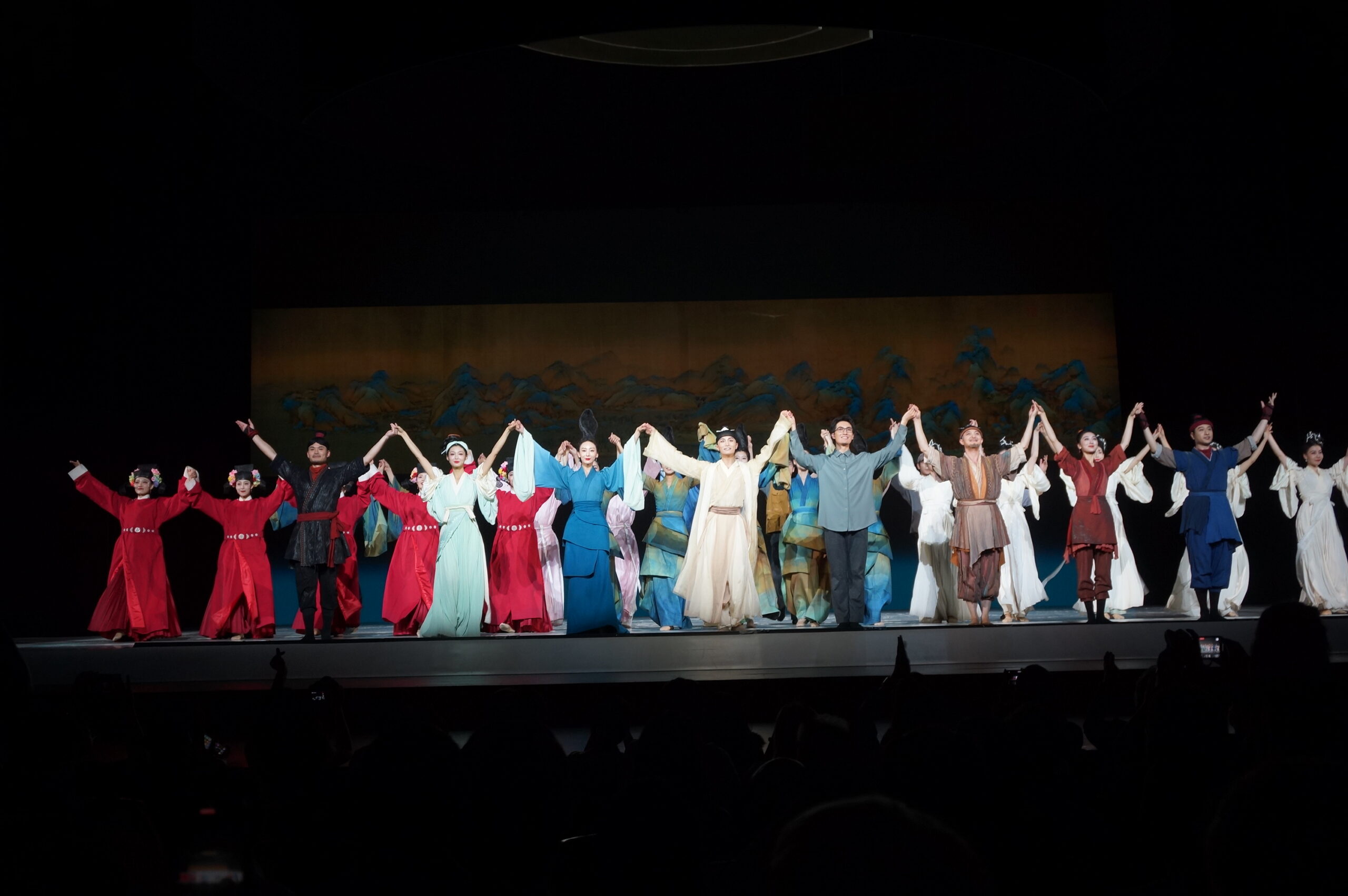
Still, it’s rare to see a production that weaves together history, art, craftsmanship, and human emotion with such elegance. The Journey of a Legendary Landscape Painting isn’t just a celebration of a masterpiece—it’s a living tribute to the spirit of artistic devotion.
This is, without question, a performance worth crossing a city—or a century—for.