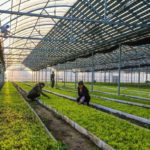
Budour Hassan, Amnesty International researcher on Israel and Palestine, discusses the destruction of Gaza’s food supply systems, including its agricultural lands, greenhouses and poultry farms.
For months, many of Gaza’s two million residents have faced what international agencies now describe as catastrophic levels of hunger.
After nearly two years of war between Israel and Hamas, over 60,034 Gazans have been killed — over 18,592 of them children.
According to the United Nations (UN), at least 1.9 million people, or roughly 90% of the population, have been displaced from their homes — some as many as 10 times or more.
The famine landscape
Now, UN-backed Integrated Food Security Phase Classification (IPC) projections report that “The worst-case scenario of famine is currently playing out in Gaza,” with over 20,000 children treated in hospitals for malnutrition since April and half a million Gazans expected to reach the worst IPC category — catastrophic famine, marked by starvation, destitution and death — by September.
From fall 2023 into late 2024, “the United States pushed Israel to provide more assistance and kept it just below that threshold … What we’ve had in the last few months is a worsening of this — a complete siege, a complete collapse in food availability,” said Alex de Waal, executive director of the World Peace Foundation and a famine expert at the Tufts University Fletcher School of Law and Diplomacy, at a Friday, 8 American Community Media briefing.

After international pressure during a two-month blockade between March and May 2025, when mass food aid struggled to reach the roughly 400 United Nations food distribution sites embedded throughout Gaza, the Israeli- and U.S.-backed American nonprofit Gaza Humanitarian Foundation (GHF) began operating at four distribution sites, with three of them located in the far south of Gaza.
As of mid-July, 875 people were confirmed killed while trying to get food, with 674 of these killed in the vicinity of GHF sites.
“The Gaza Humanitarian Foundation calls them ‘secure distribution sites.’ Well, the items are secure only up to the point where they reach that place. There is no security for the people,” said de Waal. “I can’t tell you whether they’ve been killed deliberately or if it’s simply a matter of when you have these huge crowds of people rushing to get food from a place that is only open for a few minutes, if you have a soldier nearby, he doesn’t know who’s in that crowd, could be Hamas.”
Israeli officials have justified the militarization of GHF operations with claims that food was being diverted by Hamas, but both Israeli military officials and outside analyses, including an internal American federal USAID investigation, found no proof of systematic supply theft by Hamas.
“The moment when you really see famine is when, instead of a family being able to break bread together, they fight for bread. When you get that breakdown, that is the dividing line between what it is to be a human and what it is to be an animal,” he added.

‘There’s nothing about this that is fair’
“The way in which this all felt deliberate became very real to me while I was there,” said Afeef Nessouli, a journalist who volunteered in Gaza with medical aid group Glia for nine weeks from late March to early June.
In the weeks before he arrived, he knew of roughly 170 community kitchens in operation; by the time he got there, there were dozens.
“Problems seemed like they were coming from every direction and that they were intentional,” he explained, “whether it was that there was only so much fresh produce or that there was nothing on the market beyond tuna cans that were $10 each, $15 each, flour that was hundreds of dollars to get. And then eventually there was no flour … and then I had sources and colleagues trying to get food from the GHF and being shot at.”
“Doctors had exorbitant amounts of evidence that showed that these were not accidental snipe shots,” Nessouli continued. “Morphine wasn’t always available for people with explosive injuries. “I mean, 20 year old men are tasked with being the (Palestinian) Civil Defense forces … they have to run into a site that has just been bombed and try to save as many people as possible within a certain amount of time before the second air strike might hit the same area.”

A UN report found that as of late July, 8.6% of cropland in Gaza is still accessible, while only 1.5% is both accessible and undamaged.
As of late May, Gaza had lost 94% of its fishery catch, with the average daily catch dropping to 7.3% of 2022 levels.
“When you’re there, there’s nothing about this that is fair. It is a genocide. It is intentional. There are several things happening at once, on purpose, and there is a result of one group of people being tortured and eradicated,” Nessouli added.
“There was this process of dehumanization taking place, and people described it quite painfully to us about, first of all, the breakdown of social fabric,” said Budour Hassan, an Amnesty International researcher documenting the situation in Palestine since 2022. “The first instinct of people when they see someone in need is to help each other … and then the fight over the very meager resources allowed in starts kicking in.”
“At this stage, what is needed is a full-on recovery process,” she explained. “Starvation doesn’t end in the moment that more food is allowed, because we’re talking about a completely devastated health sector system. Now we’re seeing how there is the spread of Guillain-Barré syndrome. Meningitis is spreading. In order to start the process of treatment, you need a functional healthcare sector … There must be a ceasefire for this to even start working.”

“That doesn’t mean there aren’t also many mass violations being committed by Hamas — not just against hostages, but also against Palestinians in Gaza. Even before the genocide, for the 17 years in which Hamas had been in power in Gaza, people had protested,” continued Hassan. “It’s just that the outside world was not interested in listening unless there was war. What was happening between the wars was rarely, if ever, listened to.”
“This is our obligation: When the bombs cease to fall, when the situation improves, we have to keep our eyes on Gaza,” she added. “One sentence that continues to haunt me, and I felt it was prophetic when everything restarted, was one father whose child was seriously injured in a drone strike. He said ‘This time we survived. We don’t know what will happen next. We don’t know if you’ll find us alive next.’”