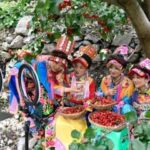
Released simultaneously in North America and China, the film brings together a cast including Jackie Chan, Ma Li, Qiao Shan, and Yu Yang, forming a layered spectrum of comedic styles. Jackie Chan delivers his signature cross-generational appeal and reassuring screen presence; Ma Li enriches the film with emotional depth beneath its comedic surface—particularly through her role as the tribal chief, a character that embodies both strength and vulnerability. Meanwhile, Qiao Shan and Yu Yang ground the humor with relatable timing and rhythm. Together, they weave a tonal fabric that resonates across age groups.
Compared to its predecessor, the film noticeably reduces its emphasis on action, shifting instead toward comedy and fantasy adventure. The story follows the panda Hu Hu and Chan’s character as they stumble into a mysterious tribe. Set within a fictionalized primitive world, the narrative avoids complexity and instead opts for clarity and accessibility, centering on a simple yet sincere theme: the importance of expressing love. This creative choice may be restrained, but it aligns precisely with the film’s family-oriented positioning.
Director Derek Hui leaves subtle but recognizable marks of his style throughout the film. Emotional threads—such as the relationship between the tribal chief and her daughter—are interwoven into the comedic pacing with restraint, allowing for moments of genuine feeling without disrupting the tone. The editing, too, demonstrates finesse: recurring musical cues and situational reversals transform potentially flat sequences into effective comedic beats. This ability to embed craftsmanship within a “light” genre adds a layer of sincerity to the film’s entertainment value.
Visually, the film benefits from on-location shooting, particularly in Wengding Old Village, whose raw textures and distinctive cultural atmosphere enrich the cinematic world. At the same time, Jackie Chan’s classic approach of turning everyday environments into action props remains intact, preserving the franchise’s signature flavor even with fewer action scenes.
Of course, the film is not without its criticisms. Some viewers point to its simplified, child-oriented storyline and occasionally repetitive humor. Yet, within the framework of its genre, Panda Plan 2: The Magical Tribe does not aim for narrative complexity or thematic depth. Instead, it embraces the essence of a family film—using charming characters, brisk pacing, and direct emotional cues to connect with its audience. By that measure, it is both focused and effective.
In an era where Lunar New Year releases increasingly prioritize scale and spectacle, a film that chooses simplicity and joy can feel refreshingly distinct. It may not strive to be the most ambitious title of the season, but it leaves audiences with a gentle sense of satisfaction—much like Hu Hu himself: round, soft, and quietly dependable.
In this sense, Panda Plan 2: The Magical Tribe may not be the most dazzling film in the lineup, but it is undoubtedly one of the most suitable choices for families seeking to share a warm, laughter-filled cinematic experience together.