“Dead to Rights”: Bearing Witness Through the Lens to Suffering and Dignity
By Richard Ren (Art Critic, Freelance Writer, LAPost)
On the evening of August 11, the film Dead To Rights held its grand premiere at AMC Atlantic Times Square in Monterey Park, Los Angeles. Acting Chinese Consul General in Los Angeles Huang Hongjiang, Deputy Consul General Li Zhiqiang, and Cultural Counselor Wang Taiyu attended, along with nearly 200 Hollywood filmmakers, veteran critics, and media professionals.
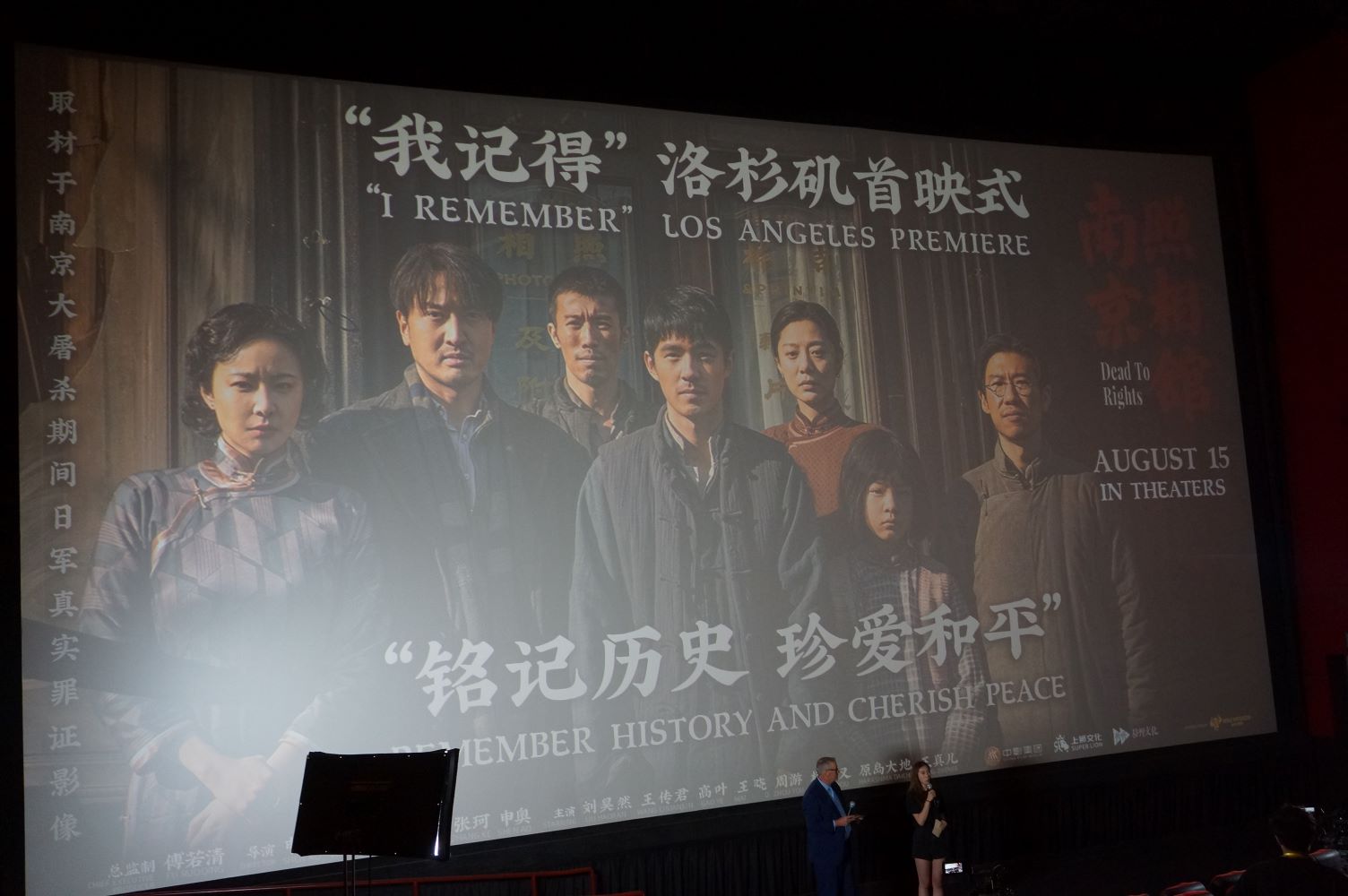
The Only Chinese Expert Viewing Group in the U.S.
What made this event particularly special was the participation of the only and largest Chinese expert viewing group in the United States, organized in Los Angeles. The group actively coordinated with the film’s distributor to invite nearly 60 active Hollywood film professionals, prominent critics, and well-known bloggers to attend the screening. They later posted professional reviews on major social media platforms, helping audiences gain a deeper understanding of the film’s historical details and artistic expression. Popular Chinese social media influencer “Jiao Jiao,” who has nearly 50 million followers, was also invited. Having just returned to the U.S. from China, he gladly accepted the invitation, attending in person and leading his team to fully document the premiere.
The Premiere Scene and Emotional Resonance
The theater was packed, every pair of eyes fixed on the screen in search of a shared memory for both the Chinese nation and humanity. Deputy Consul General Huang Hongjiang choked up during his remarks before the screening, moving the entire audience. I walked into the theater with a heavy yet expectant heart, and a friend reminded me, “Don’t forget to bring tissues.” Sure enough, before the film even ended, tears had welled up in my eyes multiple times.
Background and Core Narrative
Dead To Rights is set against the backdrop of the 1937 Nanjing Massacre, telling the story—through the perspective of an ordinary photo studio—of how a group of citizens used images to preserve the truth and resist forgetting in the midst of extreme violence. The main storyline follows studio owner Jin Chengzong (played by Wang Xiao) and young postman Su Liuchang (played by Liu Haoran), two small-town figures thrust by the tides of history to its sharpest edge. They record atrocities with their cameras, defend the truth with their convictions, and undergo spiritual transformation amid fear and pain.
The film opens with walls adorned with happy everyday photographs—newlyweds’ shy smiles, children’s innocent laughter, and warm family portraits—symbolizing the beauty of peaceful times. But when the invaders’ iron heels crushed the city, the meaning of these images was upended: the click of the shutter intertwined with the sound of gunfire, photos became evidence of atrocities, and the Japanese army even fabricated so-called “friendship photos” to whitewash their crimes.
A Choice Between Surrender and Preservation
The turning point comes in the darkroom of “Auspicious Photo Studio.” Confronted with the Japanese demand for the negatives, the staff face the choice between surrendering them or preserving them. Ultimately, unarmed, they risk their lives to pass along those images that record the truth. The frozen frames of massacres, corpse burnings, and executions are not only irrefutable evidence but also monuments of history—in this battle against forgetting, the negatives became weapons, and the shutter became witness.
Directorial Vision and Artistic Expression
Director Shen Ao adopts a powerfully realistic style, confronting massacres and atrocities head-on, using suffocating visuals to recreate historical scenes. Japanese actor Daichi Harashima, portraying a military photographer, juxtaposes the “calm plunderer” with a “civilized facade” to chilling effect. The film’s most notable innovation lies in its shift of perspective: allowing Chinese people themselves to press the shutter, reclaiming a sense of national dignity.
Ending and Emotional Crescendo
In the film’s closing moments, Lin Yuxiu escapes Nanjing with Jin Chengzong’s son and takes a photograph of a war criminal’s execution outside the city—both a cry for justice for the 300,000 victims and a message to future generations that some were willing to risk everything for the truth. Accompanied by Zhou Xuan’s 1940 song Eternal Smile, the audience sees light after darkness, and flowers amid ruins.
The Overlap of Past and Present
The credits feature a poignant montage, blending images of Nanjing’s wartime ruins with scenes of today’s bustling city and clear blue skies. Those negatives once protected at the risk of life are now akin to the everyday snapshots we casually take on our phones, delivering a silent yet profound shock through the crossing of time. One audience member remarked, “A true anti-Japanese war film is not just about hatred—it’s about awakening memory and safeguarding truth.”
From China to the World
After earning both critical acclaim and box office success in mainland China, Dead To Rights will open in theaters across the U.S. and Canada starting August 15 and is slated to launch on major streaming platforms later this year. This is not only an experiment in bringing Chinese cinema to global audiences but also a worldwide dialogue on humanity, justice, and memory.
As Ambassador Xie Feng has said, the memories of “blood and fire” exist to safeguard “the light before our eyes.” A film is entertainment, but it can also be a vessel of memory. Dead To Rights, anchored in truth and sharpened by emotion, not only revives history but also rekindles our sense of responsibility.
https://www.imdb.com/title/tt36598036/review/rw10737988/?ref_=tturv_44