China Institute at 100: A Cultural Bridge Across the Pacific Continues to Reach Forward
By Richard Ren | LAPost
NEW YORK, May 28, 2026 — The Cipriani Great Hall on Manhattan’s 42nd Street glowed with celebration on Wednesday evening as nearly 700 guests from the worlds of politics, business, academia, culture, and philanthropy gathered for the China Institute in America’s Centennial Gala, marking the 100th anniversary of one of the oldest and most influential organizations dedicated to fostering U.S.-China cultural exchange.

百年庆典晚宴(Centennial Gala)
The gala’s theme, “The Future Starts Tonight,” looked ahead even as it reflected on the past. Since its founding in 1926, the China Institute has witnessed nearly every major chapter of modern U.S.-China relations—from mutual unfamiliarity and diplomatic estrangement to normalization, cooperation, and, more recently, strategic competition. Along the way, it has served as a bridge connecting people and cultures across the Pacific.
New York City Mayor Zohran Mamdani proclaimed May 28 as “China Institute Day,” honoring the organization’s century-long contribution to cultural understanding and public education.
For many attendees, the evening was more than a celebration of an institution. It was an opportunity to reflect on a century of shared history between the United States and China.

Chinese Ambassador to the United States Xie Feng
Chinese Ambassador to the United States Xie Feng delivered remarks recognizing the Institute’s longstanding commitment to “building bridges through culture and promoting understanding through exchange.” He described the organization as both a witness to and a driving force behind mutual trust and understanding between the American and Chinese peoples. Xie also highlighted the recently opened exhibition commemorating Peking Opera master Mei Lanfang’s historic visit to the United States, calling it a vivid example of cultural exchange between Eastern and Western civilizations in a new era.
If Ambassador Xie’s remarks reflected official recognition of people-to-people diplomacy, China Institute President George Geh offered a more personal perspective on the organization’s mission.
“For the past century, China Institute has worked to demonstrate that culture can provide a stronger foundation for bilateral relations than politics alone,” he said.
The statement may be the most concise summary of the Institute’s hundred-year history.
Founded in 1926 by American educators John Dewey and Paul Monroe together with prominent Chinese scholars Hu Shih and Kuo Ping-Wen, the Institute emerged at a time when American understanding of China remained limited. Its founders envisioned an organization that would introduce Americans to the richness and complexity of Chinese civilization through education, scholarship, art, and cultural exchange.
Over the next century, the Institute hosted thousands of lectures, exhibitions, performances, and educational programs, becoming one of America’s most important gateways to understanding China.
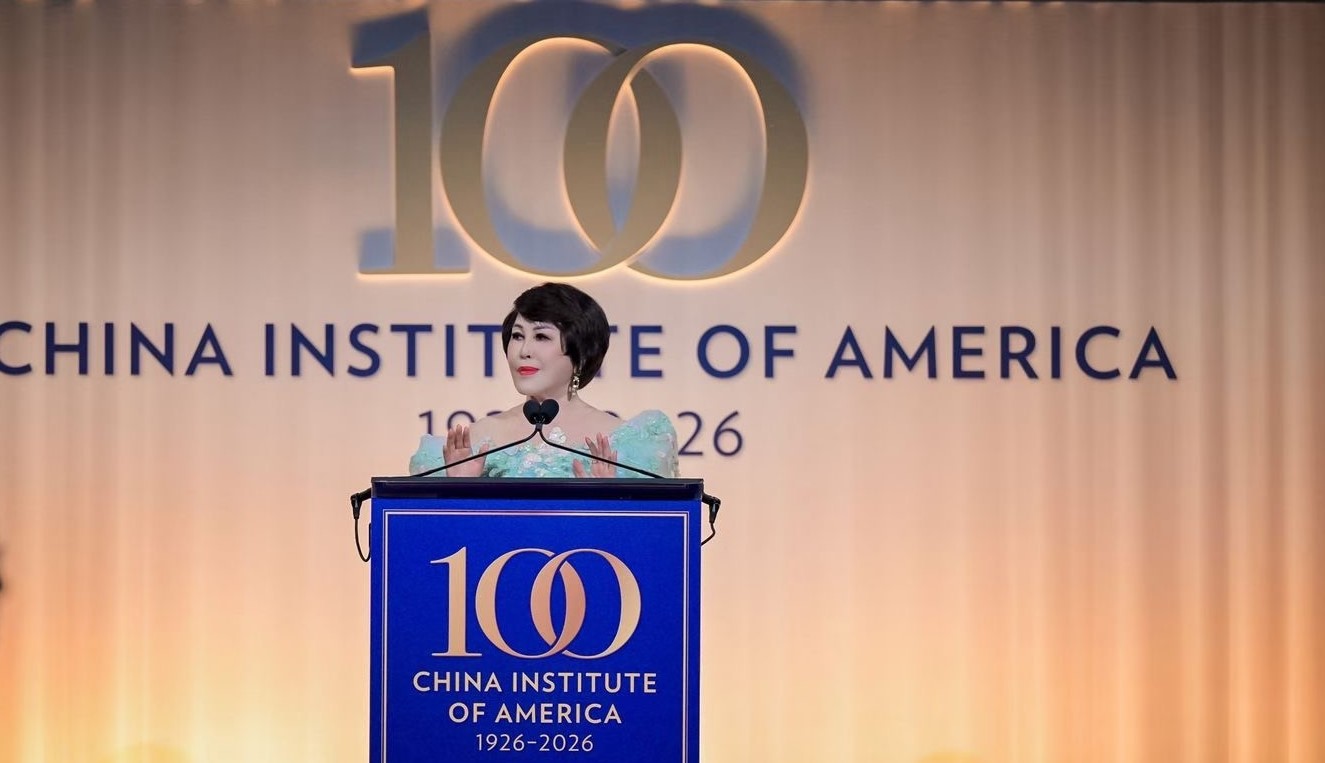
Yue-Sai Kan, co-chair of the Institute’s Board of Trustees and chair of the centennial gala
Yue-Sai Kan, Co-Chair of the Institute’s Board of Trustees and Chair of the Centennial Gala, reflected on her decades of involvement in U.S.-China cultural exchange. She argued that the force capable of transcending national borders, ethnic differences, and language barriers is not political rhetoric but genuine human connection and the trust built between civilizations.
Kan served as Gala Chair, while entrepreneur and philanthropist Lynn Chen-Zhang served as Co-Chair of the event.

Yue-Sai Kan (left), Chair of the Centennial Gala and Co-Chair of the China Institute Board of Trustees, and entrepreneur-philanthropist Lynn Chen-Zhang (right), Co-Chair of the gala, pose during the China Institute’s Centennial Celebration in New York.
Chen-Zhang traced the origins of the Institute to what she described as “a remarkable transformation—from conflict to education, from indemnity to understanding, and from history to bridge-building.” She emphasized that the China Institute was not created by any government but by educators, scholars, and bridge-builders, and that for a century it has remained an independent American nonprofit organization dedicated to education, culture, and mutual understanding.
“Our founders could never have imagined that 100 years later, China Institute would still be standing so strongly, carrying forward the same mission,” she said.
One of the evening’s highlights was the presentation of the China Institute Centennial Awards.
Among the honorees was Tung Chee-hwa, the first Chief Executive of the Hong Kong Special Administrative Region, recognized for his longstanding contributions to promoting mutual understanding between the peoples of China and the United States. Unable to attend in person, he was represented by his son, Andy Tung, Vice Chairman of the China-United States Exchange Foundation.
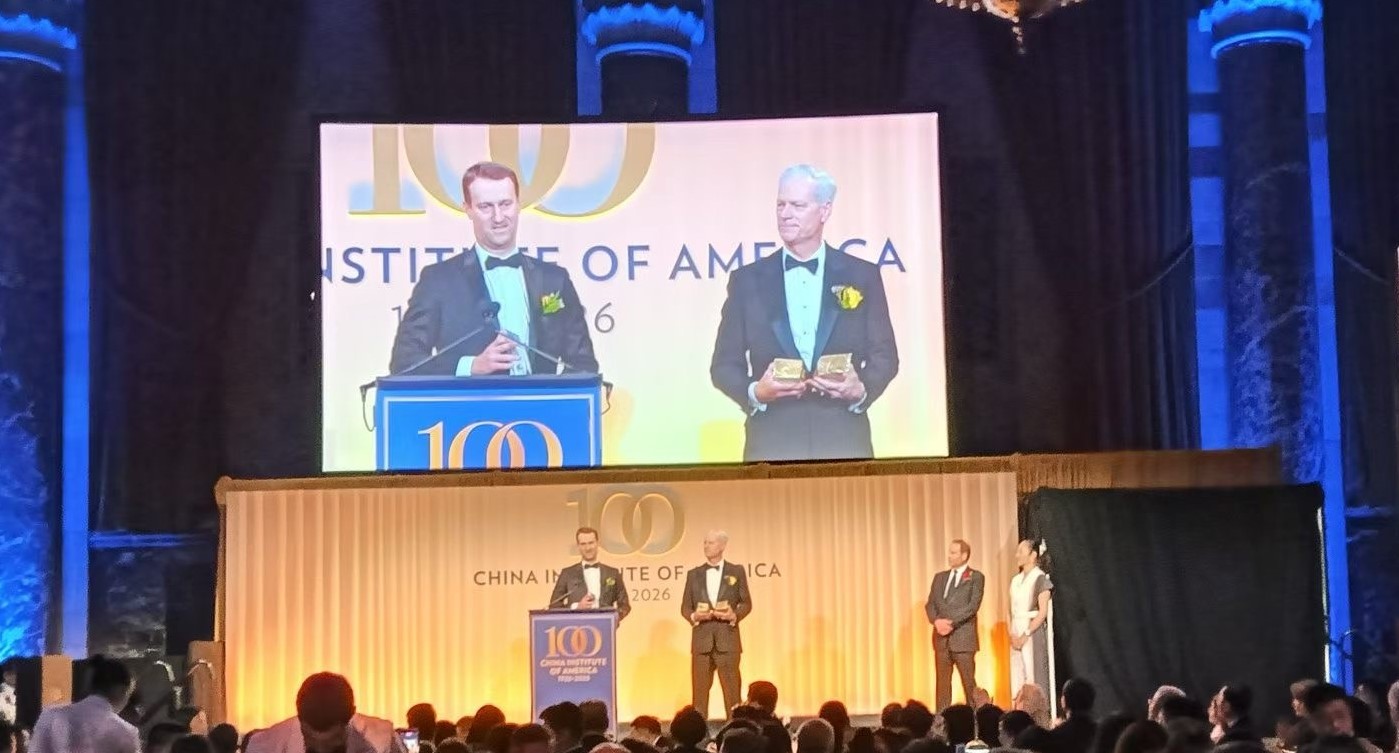
When China Institute celebrated its 50th anniversary, longtime supporter and then–U.S. Vice President Nelson Rockefeller and his wife hosted the celebration at The Plaza Hotel in New York. Half a century later, his son and grandson returned for the centennial gala, accepting an award in honor of the Rockefeller family’s enduring contribution to U.S.-China cultural exchange.
Other honorees included the Nixon family, the Bush family, the Rockefeller family, Dr. Kai Li—member of both the U.S. National Academy of Engineering and the Chinese Academy of Engineering—and Dr. Yi Cui, a member of the U.S. National Academy of Sciences, foreign member of the Chinese Academy of Sciences, and professor at Stanford University.
The awards represented more than individual achievements; together, the recipients embodied key chapters in the history of U.S.-China relations.
When China Institute celebrated its 50th anniversary, then-U.S. Vice President Nelson Rockefeller and his wife personally hosted the celebration at The Plaza Hotel in New York. Fifty years later, his son and grandson attended the centennial gala and accepted the award on behalf of the Rockefeller family.

As a presenter at the gala, acclaimed actress Joan Chen honored Christopher Nixon Cox, grandson of former President Richard Nixon, recognizing the contributions of Nixon and his family to the development of U.S.-China relations.
Acclaimed actress Joan Chen presented an award to Christopher Nixon Cox, grandson of President Richard Nixon, honoring the Nixon family’s role in advancing U.S.-China relations.
These honorees came from the worlds of politics, science, business, and philanthropy, yet collectively they tell the story of engagement between the two nations.
President Richard Nixon’s historic 1972 visit to China opened the path toward normalization of relations. George H. W. Bush maintained a deep interest in China long before becoming president. The Rockefeller family has supported educational and cultural exchanges between the two countries for decades. Scientists such as Yi Cui and Kai Li represent a new generation of academic and technological collaboration.
At a time when U.S.-China relations face increasing complexity and uncertainty, the presence of these individuals and families served as a reminder that bilateral ties are shaped not only by diplomatic agreements and trade statistics, but also by generations of people committed to dialogue and understanding.

Yue-Sai Kan and her friends
The centennial celebration, however, did not begin with the gala.
One of the most significant events in the yearlong program was The Dancing Goddess: Mei Lanfang in America, an exhibition that opened on March 11, 2026, at the China Institute Gallery in New York. Through rare archival materials, photographs, and multimedia presentations, the exhibition revisits Mei Lanfang’s landmark 1929 tour of the United States. Nearly a century ago, the legendary Peking Opera artist introduced American audiences to the beauty of Chinese theater, creating one of the defining moments in the history of U.S.-China cultural exchange. As the Institute enters its second century, the exhibition serves both as a reflection on its past and a reaffirmation of its mission to foster understanding through culture.
Earlier this year, China Institute partnered with the Shanghai Museum to host a Centennial Lunar New Year Family Festival, bringing Chinese traditional arts, cultural treasures, and interactive technology experiences to New York audiences. Another event, Spring in Jiangnan, introduced local children and families to Chinese calligraphy, painting, and the traditions of the Jiangnan region.
In April, the Institute joined East China Normal University in hosting the “Voices of the Future: U.S.-China Youth Education and Cultural Exchange Forum,” marking two decades of collaboration and bringing together young scholars from both countries to discuss education, technology, and cultural engagement.
The centennial celebrations will continue throughout the year. Upcoming events include participation in Lincoln Center’s “China Night” program in July, an outdoor concert in Central Park in August, and a fashion gala in September.
“A centennial is not only a celebration; it is also a moment for reflection,” Kan said. “We must ensure that the mission of promoting U.S.-China cultural exchange is not only preserved, but strengthened and carried forward into the next hundred years.”
Though varied in form, these initiatives share a common purpose: extending dialogue beyond governments to ordinary citizens, younger generations, and future leaders.

The evening itself embodied that spirit. The gala opened with a 90-second robotic performance accompanied by a specially commissioned centennial theme song blending hip-hop, electronic, and contemporary music. Moments later, performers presented excerpts from the classic Peking Opera masterpiece The Drunken Concubine. The juxtaposition of cutting-edge technology and traditional Chinese artistry symbolized the Institute’s commitment to preserving cultural heritage while embracing innovation and the future.


Lynn Chen-Zhang with her friends
As guests departed into the Manhattan night, conversations about the future of U.S.-China relations continued long after the final applause.
For an institution founded in 1926, a centennial may be less an ending than a beginning.
In a world shaped by shifting geopolitical realities and evolving international relationships, China Institute continues to champion the belief held by its founders a century ago: understanding does not emerge from proximity alone, but from sustained communication. The value of a bridge lies not in the moment it is built, but in its ability to be crossed again and again by future generations.
As U.S.-China relations enter a new chapter, that cultural bridge across the Pacific continues to extend forward.