Seeing Family and Society Through a Toilet Seat: The Liftist Sparks Laughter and Reflection at Hollywood Fringe Festival
LAPost / Los Angeles (June 7, 2026) – The original dark comedy The Liftist, created by a group of young Chinese theater artists, opened its premiere run on the evening of June 7 at the Hollywood Fringe Festival in Los Angeles. As one of the official main competition selections of this year’s festival, the production is produced by Lucy Ma and M&M Arts and Productions Inc., with Julie Zhu serving as co-producer. Written by Amy Dong and Mason Ma and directed by Zhi Qu, the play launched a five-performance run at the Davidson/Valentini Theatre. Starting from a seemingly trivial household dispute—whether a toilet seat should be left up or down—the work gradually unfolds into a layered exploration of family responsibility, gender roles, emotional labor, and intergenerational relationships through dark humor and absurdist storytelling.
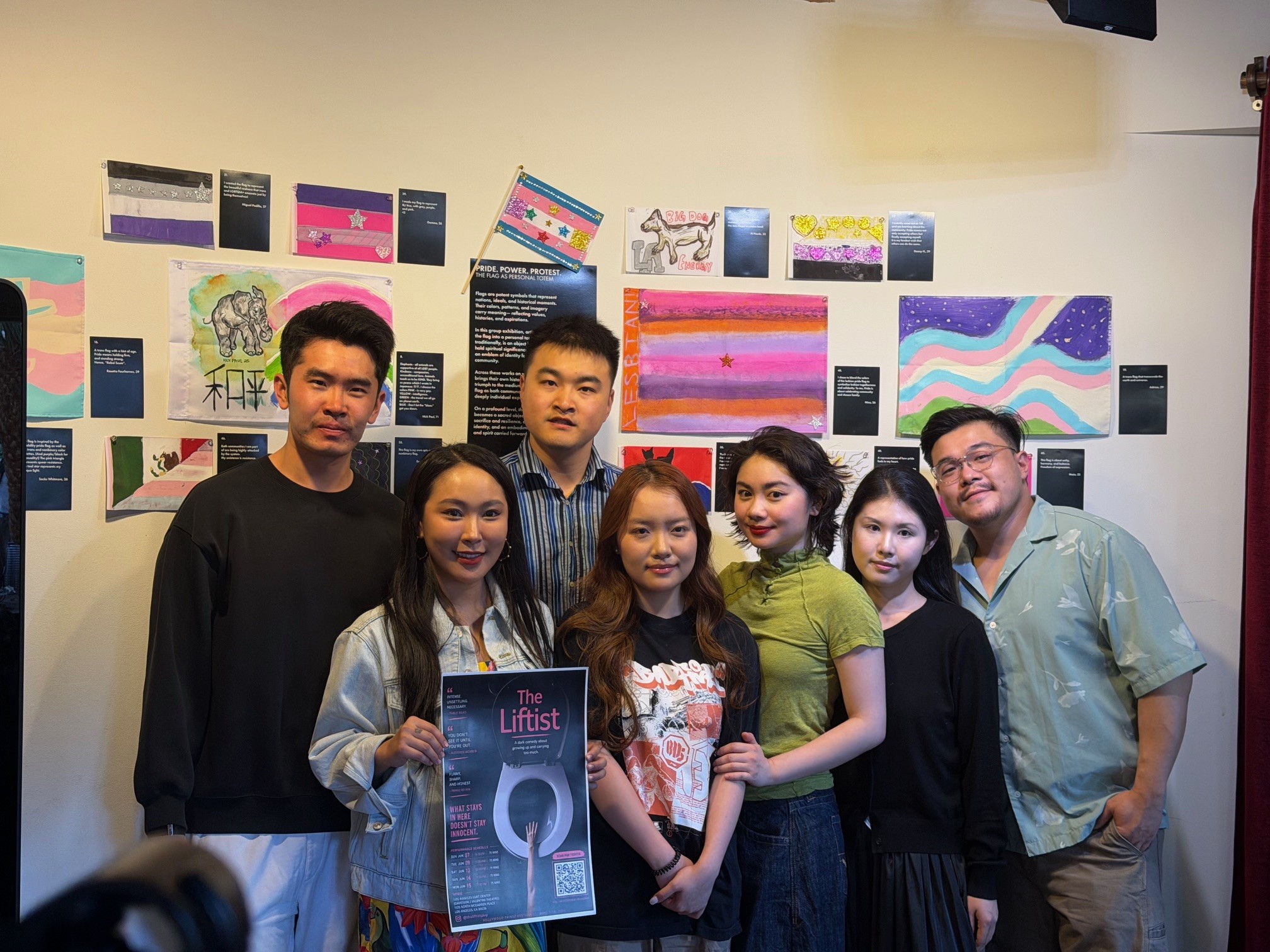
Ma Qianhui (front row, first from left) and Zhi Qu (back row, second from left) join the cast of The Liftist in a post-show interview following the performance. (Photo by: Richard Ren / LAPost)
As one of the most influential independent theater gatherings on the U.S. West Coast, the Hollywood Fringe Festival is held every summer in Hollywood. Its main venues are concentrated along the “Hollywood Theatre Row,” a 1.4-mile stretch of Santa Monica Boulevard in Los Angeles. Unlike many curated festivals, Hollywood Fringe operates on an open-access model, allowing all eligible original productions to participate rather than being selected through a formal programming process. As a result, it has become both an incubator for experimental theater and emerging artists, as well as an important platform for creators from diverse cultural backgrounds to present original works.
In keeping with its reputation for encouraging experimental, original, and multicultural expression, The Liftist reflects the spirit of the festival. Although its creative team is largely based in New York, the production chose Los Angeles for its premiere, completing an ambitious original work under limited budget and a compressed rehearsal timeline that blends entertainment with social reflection.
The story of The Liftist revolves around a debate familiar to many households—whether a toilet seat should be lifted—and expands this everyday detail across a twenty-year timeline into an examination of household division of labor, emotional work, intimacy, and broader social structures.
In the play, the protagonist Ashley grows from adolescence into adulthood, confronting not only her father, partner, and family expectations, but also continuously questioning: who is responsible for the labor that is often taken for granted? And what happens to relationships when such responsibilities are persistently ignored?
At the premiere, laughter frequently erupted from the audience, while extended silences followed key scenes. In the post-show talkback, director Zhi Qu noted that such silence was precisely the effect the production aimed to evoke.
“Most of the time, what people are arguing about is not really the toilet seat itself, but the unspoken expectations and emotions behind it,” he said.
Qu explained that during the script development and staging process, he worked closely with dramaturg Khione Han to refine the creative approach, gradually establishing the guiding vision: to use small domestic details to illuminate larger structural issues in modern urban life. A minor everyday habit can accumulate into family conflict, gender dynamics, and systemic questions of labor division. The final act extends the narrative into a future world, introducing artificial intelligence elements that further amplify the contemporary relevance and trajectory of these issues.
Producer Lucy Ma acknowledged that the concept of The Liftist had been in development for many years.
“The idea was already in my mind six or seven years ago, but I never found the right opportunity to realize it,” she said. “Only in recent years, with the support of friends, artists, and collaborators who believed in the project unconditionally, did it finally come to life.”
Ma graduated from the University of California, Santa Barbara, and later earned her master’s degree from the California Institute of the Arts. She has also participated twice in Los Angeles theater festival productions. Director Zhi Qu also graduated from UC Santa Barbara and later received a master’s degree from New York University, where he directed large-scale stage productions, theater works, and operas.
Although The Liftist is presented as a black comedy, its core is not cynical or harsh, but rather grounded in a subtle humanistic sensibility. The writers avoid portraying men or women as simple “problems,” instead highlighting how individuals of all genders can become trapped in the pressures of modern family life.
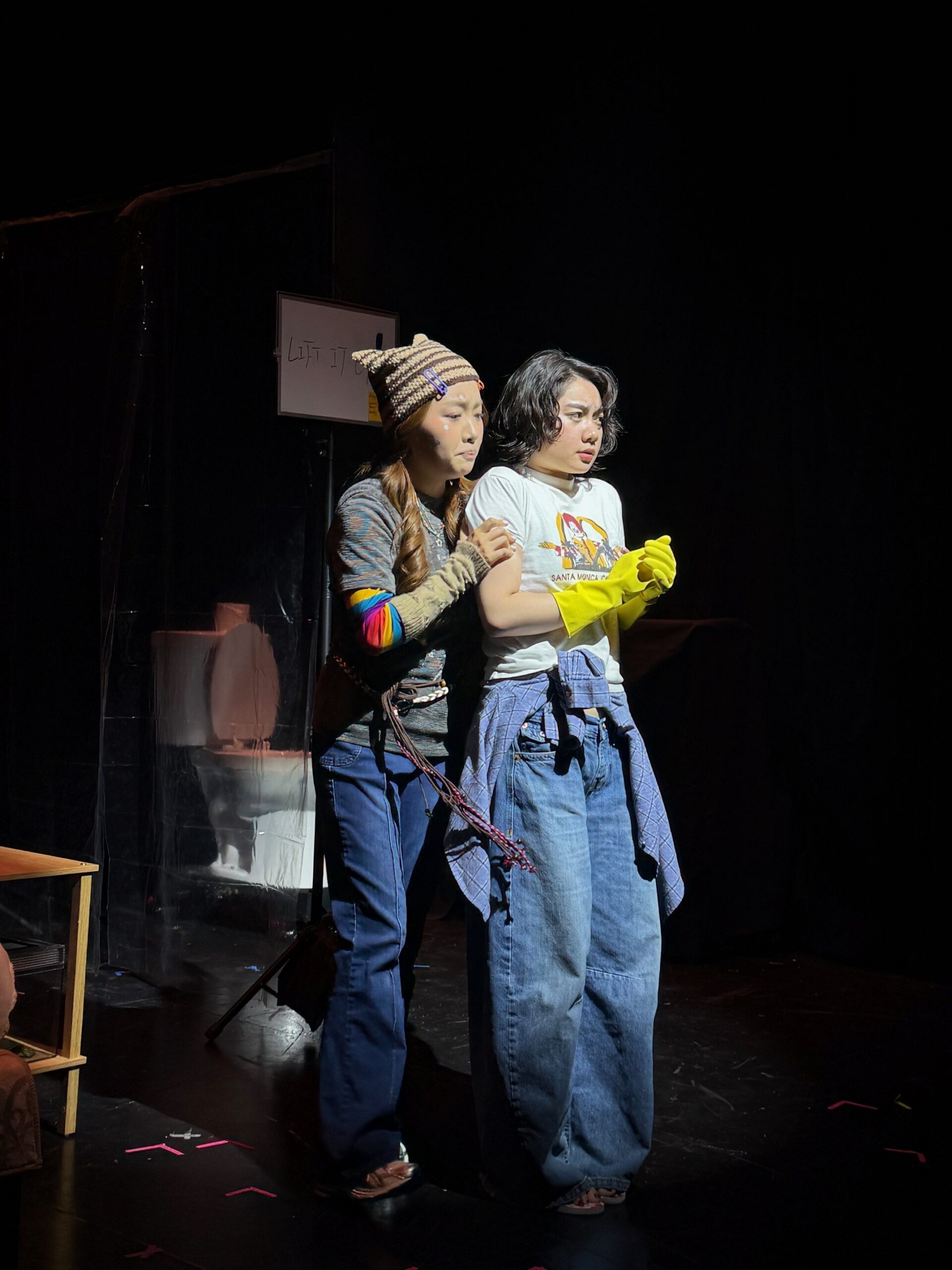
(Photo by: Richard Ren/LAPost)
As the play suggests: in relationships marked by unequal division of labor, there are no real winners.
Actress Jingyao Zhao, who plays Ashley, said after the performance that what moved her most was the often-overlooked nature of domestic labor. “In every household, there is so much invisible work and emotional effort. People often take it for granted, but someone is always quietly carrying it. We hope those unseen parts can finally be acknowledged.”
The ensemble cast delivers a wide range of roles across multiple timelines and realities. John Jiang, Yuchen Zhou, and Summer Xia each portray multiple characters, ranging from a middle-aged firefighter father, an eccentric best friend, and a New York office worker, to surreal figures such as the “Toilet King,” a nurse, and even the historical inventor of the flushing toilet. Their performances bring credibility and emotional texture to each role. Shuwen Pan, who plays the artificial intelligence character Dylan, constructs a performance through precise control of rhythm, physicality, and voice, successfully embodying a presence that is “almost human, yet distinctly other.”
From a design perspective, The Liftist demonstrates the imagination of a young creative team. Set designer Siyin Yan builds the visual world around the motif of a bathroom space, balancing realism and symbolism. Lighting designer Tilda Seo uses color and contrast to create surreal transitions across time. Original music and sound design by Silvan Tang heighten the play’s absurdist tone, while costume designer Nuoyan Guan traces characters’ development across three decades. As production stage manager, Sijia Zhang ensured coordination across departments during rehearsals and technical runs, maintaining the production’s overall coherence and quality.
The latter part of the production is particularly striking in its bold vision of the future. What begins as a domestic argument in a bathroom expands into questions of technological development, artificial intelligence, and shifting social structures, pushing the play beyond the boundaries of a traditional family comedy.
Audience member Fina Zhou, who attended the premiere, said she was initially drawn in by the premise of “a play about a toilet,” but ultimately surprised by its depth. “It’s not really about the toilet—it’s about human relationships. I especially liked how it connects family, growth, and AI. The ending even reminded me of Everything Everywhere All at Once, with that struggle between escape and searching for a way out. It really resonated.”
For Chinese-language theater creators, producing original English-language work for a major U.S. theater festival is no easy task. While The Liftist may still have room for refinement, its most important strength lies in its willingness to speak boldly.
It does not attempt to tell the world through grand narratives. Instead, it begins with something as ordinary as a toilet seat.
And as audiences leave the theater laughing, they may also find themselves reflecting on the smallest, most overlooked parts of everyday life: who performs the invisible labor at home, and who quietly does the work that is “not our job, but we do it anyway.”
As the play’s central line states:
“It’s not our job, but we do it anyway.”
This is not only the dilemma of the characters on stage, but also a shared reality in many modern households. For a Fringe Festival production, the ability to leave audiences thinking after laughter may already be its most important achievement.
(By: Richard Ren/LAPost)
Performance Information
The Liftist
Hollywood Fringe Festival 2026
Showtimes:
- Sunday, June 7, 2026 — 5:00 PM
- Tuesday, June 9, 2026 — 7:30 PM
- Saturday, June 13, 2026 — 3:15 PM
- Sunday, June 14, 2026 — 1:30 PM
- Monday, June 15, 2026 — 7:30 PM
Venue:
Davidson / Valentini Theatre
1125 N McCadden Place
Los Angeles, CA 90038