Four months after Guan Heng was released from an immigrant detention facility in upstate New York, the asylum seeker from China is still struggling with sleep. At the supermarket, he says, water bottles with the brand name Sparkling Ice make him flinch.
Guan, 38, was detained for five months by Immigration and Customs Enforcement (ICE), during which he said he experienced the “most terrifying” time of his life.
Which is surprising coming from Guan. Years earlier he risked his own safety and freedom when he traveled to western China’s Xinjiang Province. There he documented internment camps that, according to human rights groups, have housed anywhere from 1 to 2 million Uyghur Muslims.
“The Xinjiang trip was very dangerous. But I could mitigate the risk,” said Guan. His footage — released on YouTube in 2021 — provides rarely seen evidence of China’s human rights abuses targeting its Uyghur minority population. But under U.S. immigrant detention, he added, “there was nothing I could do.”
A beacon of democracy
Guan is among a new wave of Chinese dissidents to seek refuge in the US. Some 80,000 Chinese nationals either came to the country or, for those already here, adjusted their status following Beijing’s brutal crackdown on student demonstrators protesting in Tiananmen Square in 1989. Tens of thousands more similarly fled China’s draconian COVID-19 measures during the pandemic.
For many — despite current democratic backsliding — the blueprint drawn by the US founding fathers in the Declaration of Independence, 250 years ago remains a beacon and reference point for changes they want to see in their home country.
Born in the late 1980s, Guan grew up in a resurgent China. The country was brimming with confidence and a rising sense of nationalism. By his early 20s, he began to drift from one short-term job to another. He started traveling abroad and posting clips of his journeys on social media.
COVID lockdown
Then COVID hit. Over weeks and months Guan encountered a stream of videos online depicting the struggles of millions under pandemic lockdown. He says this is when his mind began to turn to social issues.
In early 2020, Guan worked his way past China’s internet firewall. He stumbled onto a satellite image depicting a map of the internment camps in Xinjiang published by the online site Buzzfeed News. Later that year, as COVID lockdown rules eased somewhat, he hopped in his car and headed to Xinjiang to see for himself.
He arrived in the US the following year, after first flying to Ecuador and then the Bahamas. From there he boarded an inflatable boat and sailed to Florida. He later applied for asylum and eventually settled in New York. The city, he says, felt more “real” to him than his native China.
“I saw the garbage in Times Square, and homeless people on Wall Street,” said Guan. “In China, places like this would be made spotless and flawless. But that’s a fake image.”
Four years later, another reality hit.
On the morning of August 20, 2025, Guan woke up to gun wielding ICE agents in his bedroom in a house in Albany, New York, that he shared with five other Chinese immigrants. The agents arrested Guan, along with two other Chinese nationals who also had asylum cases pending.
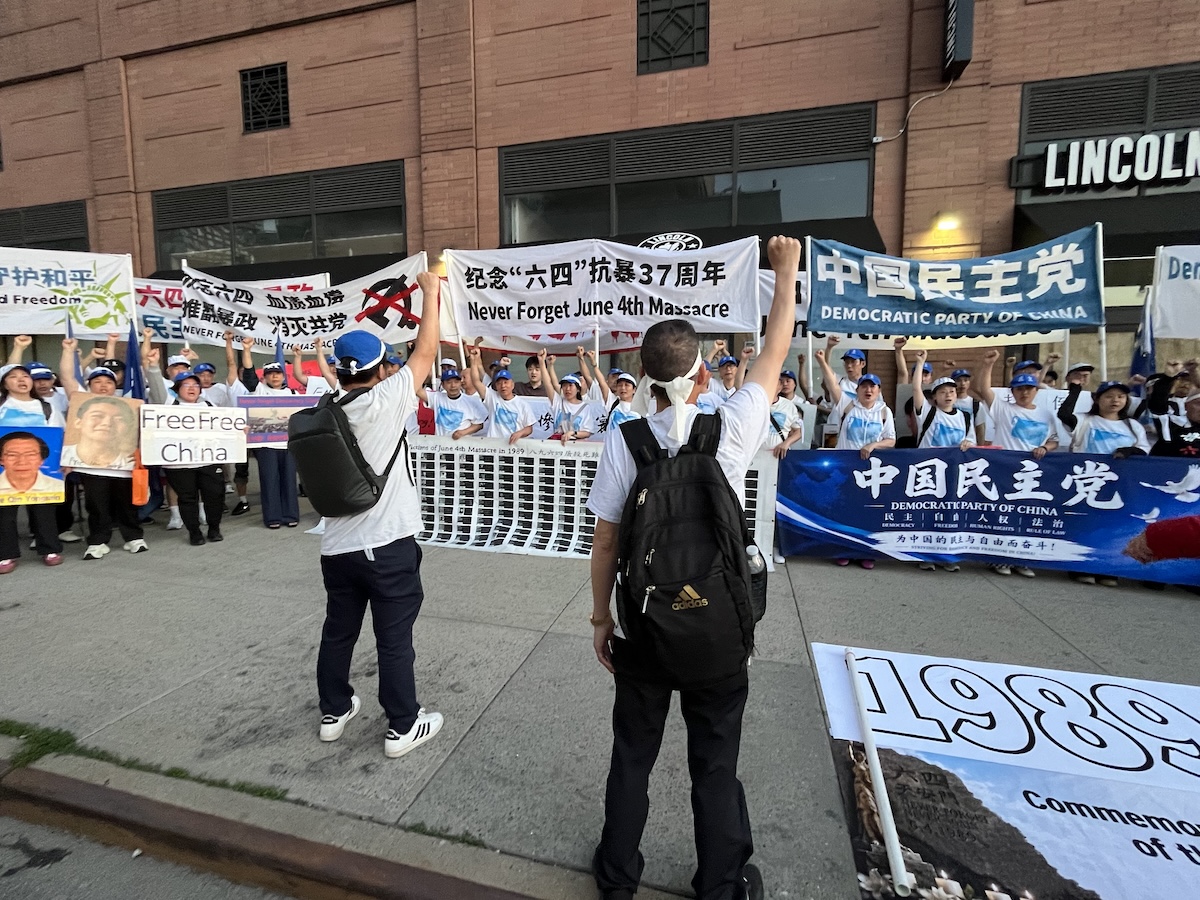
4, 2026. (Credit Rong Xiaoqing)
A sense of betrayal
Immigration agents detained Zhu Dongdong last October when he went in for a routine check-in in New York.
Dissidents like Zhu are all too familiar with the horror stories of asylum seekers — especially more prominent figures — sent back to China. Some recount decades-long imprisonment or people who simply disappeared. He worries he’ll be tortured or even executed if he is deported.
But like many Chinese asylum seekers here, Zhu also describes a feeling of betrayal. That sense is especially acute given his deeply held convictions about the strength and promise of U.S. democracy.
“I followed their procedure. I have no criminal record,” he said. “Why arrest me? Isn’t this a country of law and order?”
Data shows that since Trump’s anti-immigrant crackdown began close to 3,000 Chinese nationals have been detained or deported. More than 140,000 Chinese nationals are currently in the US seeking asylum.
‘I have no way back’
Zhu crossed the Mexican border into the U.S. in 2022 after fleeing China, where he spent 10 days in detention for protesting the government’s COVID policies. Like Guan, he later made his way to New York. One day after arriving, he went to see the Statue of Liberty. While there he read Emma Lazarus’s famous 1883 sonnet etched on the pedestal.
“I firmly believed those words,” recalled Zhu.
In November 2023, when Chinese President Xi Jinping met then President Biden in San Francisco, Zhu participated in a protest where he and others were attacked by pepper spray wielding men. He believes they were hired thugs working for the Chinese Communist Party.
Zhu was unflinching then. But now, after his arrest by ICE and then losing his asylum case, he has slid into severe depression. He is currently appealing his case. “I have to win the appeal. I have no way back,” said Zhu, speaking through a payphone at a detention center in Mississippi.
‘Disappointment runs deep’
Wan Yanhai runs Information for Chinese Immigrants, a non-profit based in Flushing that helps Chinese dissidents navigate life in the country. A veteran activist, he was among the protesters at Tiananmen nearly 40 years ago.
“Many Chinese dissidents carry trauma from their fights against the CCP,” said Wan, adding fear of arrest by ICE is now exacerbating that sense of vulnerability.
Wan is of that generation of Chinese activists who saw in the US an ideal form of governance. “Learning from America was almost a mission for us then,” he said. “The US defined our understanding of human society.”
Under the current administration, he admits that long-held belief has now been shaken.
Zhou Fengsuo, a student leader during the Tiananmen Square protests, embodied the ideals of young pro-democracy activists in China back then. The first public speech he made on the square, on April 18, 1989, was about how China should learn from the American constitution to improve its own.
“We have deep emotional ties with the US,” said Zhou, who came to the country with the help of the American government. “So our disappointment in recent years also runs deep.”
Turning away from Trump
In his first term, Trump’s tough stances on issues like the trade war and the origins of COVID won the president support from former Tiananmen protesters. Many hoped that he might be the person who would help end CCP rule.
Liqun Chen was among them. Deeply involved in China’s democracy movement throughout the 1970s, Chen voted for Trump in each of the last three presidential elections. Now she says she is no longer a fan.
“We were hoping the US would lead the world to democracy,” said Chen, who lives in New York. With Trump expressing admiration for China’s president, Xi Jinping, and his tepid response to defense of Taiwan, among other issues, she says she and many others are withdrawing their support.
“President Trump is more interested in doing business with China. But you cannot trade human rights for business,” she said.
The beacon won’t fail
Still, many Chinese dissidents maintain their faith in the country’s founding principles. “The beacon may need to be burnished sometimes, but it won’t fall,” said Chen, “because it stems from the people.”
Perry Link, emeritus professor of East Asian studies at Princeton University and an expert on China’s democracy movement, agrees, noting Chinese dissidents in the US are less apt to be panicked about the dire state of democracy here.
These individuals, he says, come from a place where there are no restrictions on government power, while in the US the system of checks and balances has restrained the president numerous times.
“To see the January 6 rioters as a profound threat to the country makes little sense to people who have witnessed the June Fourth massacre and other CCP outrages,” said Link, pointing to Tiananmen.
Guan echoes that sense of optimism.
Still struggling to make ends meet as a deliveryman, he cannot afford to renew the insurance on a second-hand van that lapsed during his detention. Before the arrest, he was working to convert the vehicle into a trailer for a road trip across the US that he wanted to document, much as he had during his earlier travels.
And he still struggles with the memories of his time in detention, in particular when authorities threatened to deport him to Uganda.
But, he says, despite all the setbacks, he remains confident in the foundations of American democracy. “When I see the public outcry that current immigration policies have triggered, and American citizens dying under ICE’s guns to protect immigrants, I know this country has hope.”
This story was supported by and co-published with the America’s 250th Project | American Academy of Arts & Sciences.