Two China–U.S. Pairings Debut at WTT US Smash, Earning Standing Ovations Despite First-Round Exits
LAPost / Ontario, California (By Richard Ren) – June 29, 2026 — Competition continued Monday at the 2026 WTT US Smash at the Ontario Convention Centre in Southern California, where one of the tournament’s most symbolic storylines unfolded: two China–U.S. doubles partnerships took the court in the main draw.
The Chinese national team fielded two non-core players to partner with members of Team USA in the men’s doubles and mixed doubles events, with both pairings competing on wild cards. It marked the first time in US Smash history that two China–U.S. combinations appeared in the same tournament, adding a heartwarming dimension of cross-cultural friendship and sporting cooperation to the competition.
Although both pairs were eliminated in the opening round, they received warm applause from the crowd and quickly became one of the most talked-about stories among fans and the media. Coinciding with the 55th anniversary of U.S.–China Ping-Pong Diplomacy, the sight of Chinese and American players standing on the same side of the table carried a significance that extended well beyond the final scores.
Many Chinese American spectators enthusiastically applauded as the two international pairings entered the arena, with some waving both Chinese and American flags in support. One fan from Los Angeles remarked, “Winning and losing isn’t the most important thing today. Seeing Chinese and American players competing together on the same side of the table is one of the best expressions of the spirit of sport.”
Two Wild Card Partnerships Fall in the Opening Round
As wild-card entries, both international partnerships faced difficult first-round matchups.
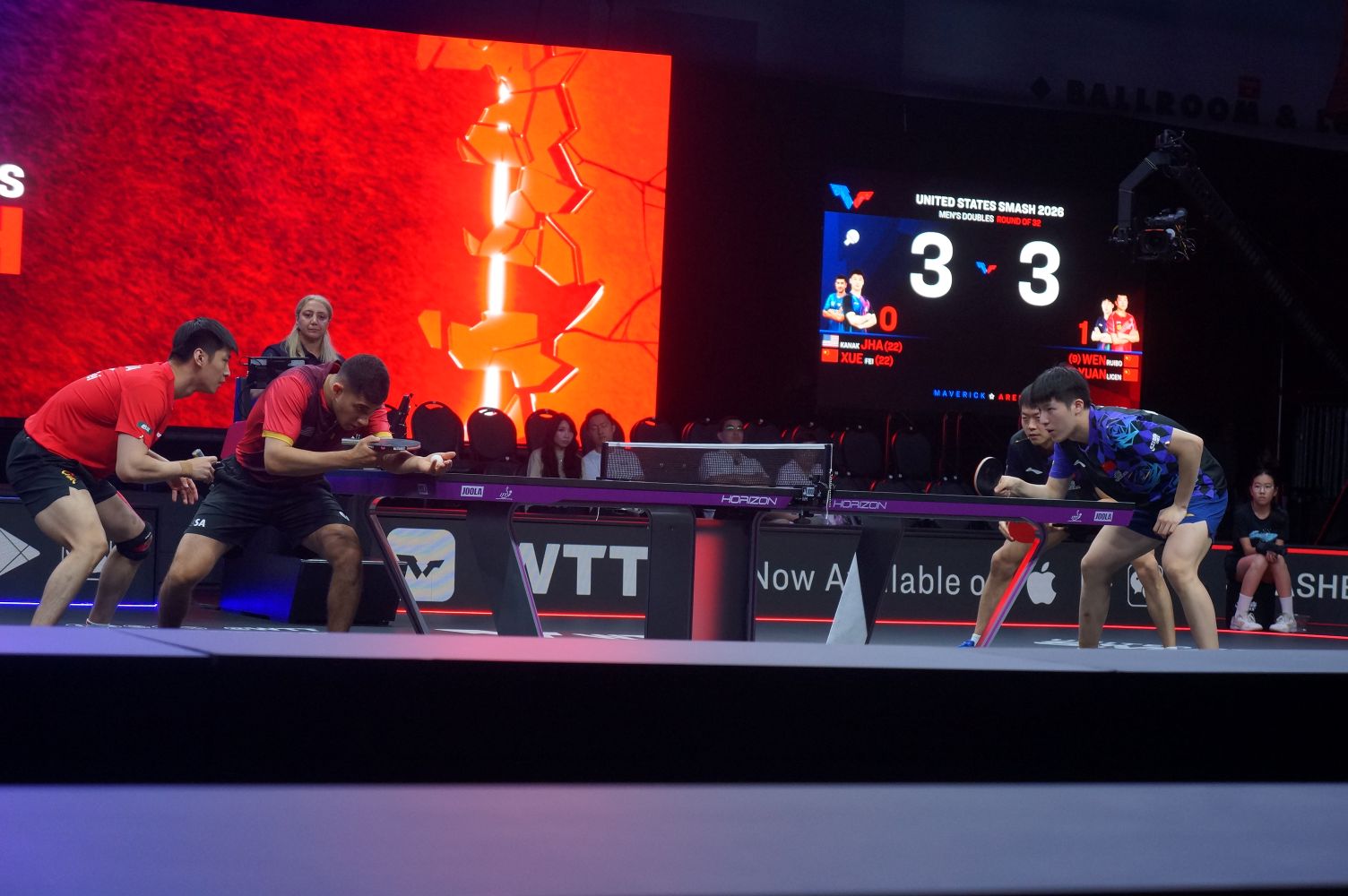
Xue Fei of China and American star Kanak Jha face China’s Wen Ruibo and Yuan Licen in the men’s doubles first round. (Photo by Richard Ren/LAPost)
In the men’s doubles event, China’s Xue Fei teamed up with American standout Kanak Jha against fellow Chinese players Wen Ruibo and Yuan Licen, currently ranked World No. 68 as a pair. Familiar with each other’s playing styles, the match featured several high-quality rallies. Xue and Jha captured the third game 11-8 but ultimately fell 9-11, 6-11, 11-8, 9-11.
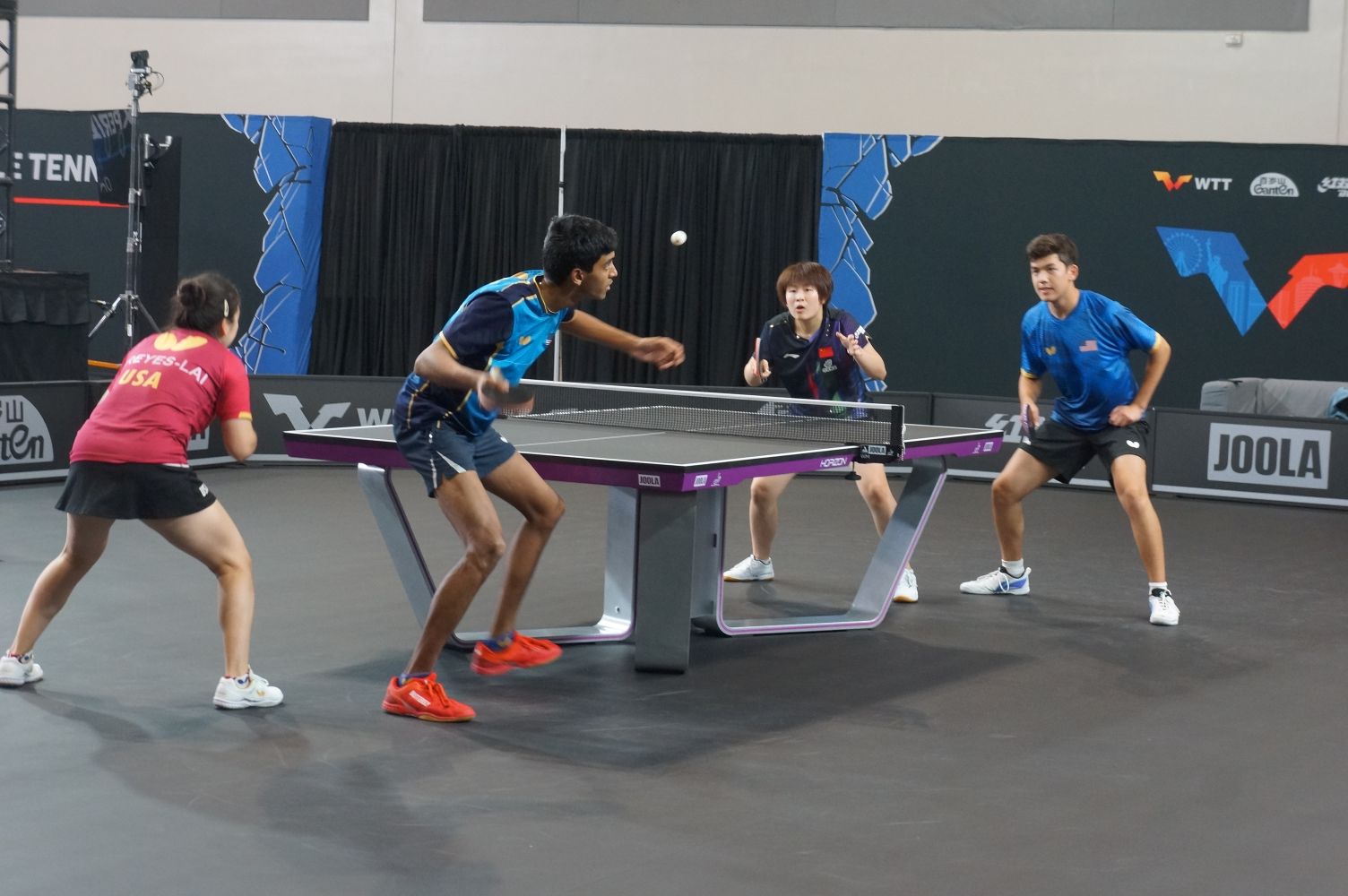
American player Bosman Botha and China’s Qin Yuxuan compete against U.S. pair Nandan Naresh and Jessica Lai in the mixed doubles first round. (Photo by Richard Ren/LAPost)
In mixed doubles, American player Bosman Botha partnered with China’s Qin Yuxuan to face American wild-card duo Nandan Naresh and Jessica Lai. The opening game was tightly contested before Botha and Qin narrowly lost 12-14. They then dropped the next two games 5-11 and 6-11, exiting the tournament in straight games.
Despite the defeats, both China–U.S. partnerships exchanged handshakes and high-fives after their matches, while spectators rewarded their efforts with sustained applause in recognition of their teamwork and sportsmanship.
Four Players, Four Different Journeys
The two international pairings brought together four athletes from remarkably different backgrounds.
Qin Yuxuan is regarded as one of China’s promising young talents. Known for her refined technique and strong short-game skills, she has steadily emerged on the international stage and gained valuable experience through this unique cross-national partnership.
Her compatriot Xue Fei is an experienced member of the Chinese men’s team, recognized for his traditional penhold style and years of success on the international professional circuit.
Kanak Jha, meanwhile, has long been one of the leading figures in American table tennis. A prodigy from a young age, he has represented the United States at multiple Olympic Games and World Championships and remains a cornerstone of Team USA.
Among the four players, however, it was young American Bosman Botha who became one of the most popular figures in the media mixed zone.
Mandarin-Speaking Botha Becomes a Social Media Favorite
Tall, athletic and charismatic, Botha immediately attracted the attention of photographers and content creators covering the tournament. What surprised many even more was his ability to conduct interviews in fluent Mandarin, speaking comfortably with Chinese reporters and quickly gaining popularity across Chinese social media.
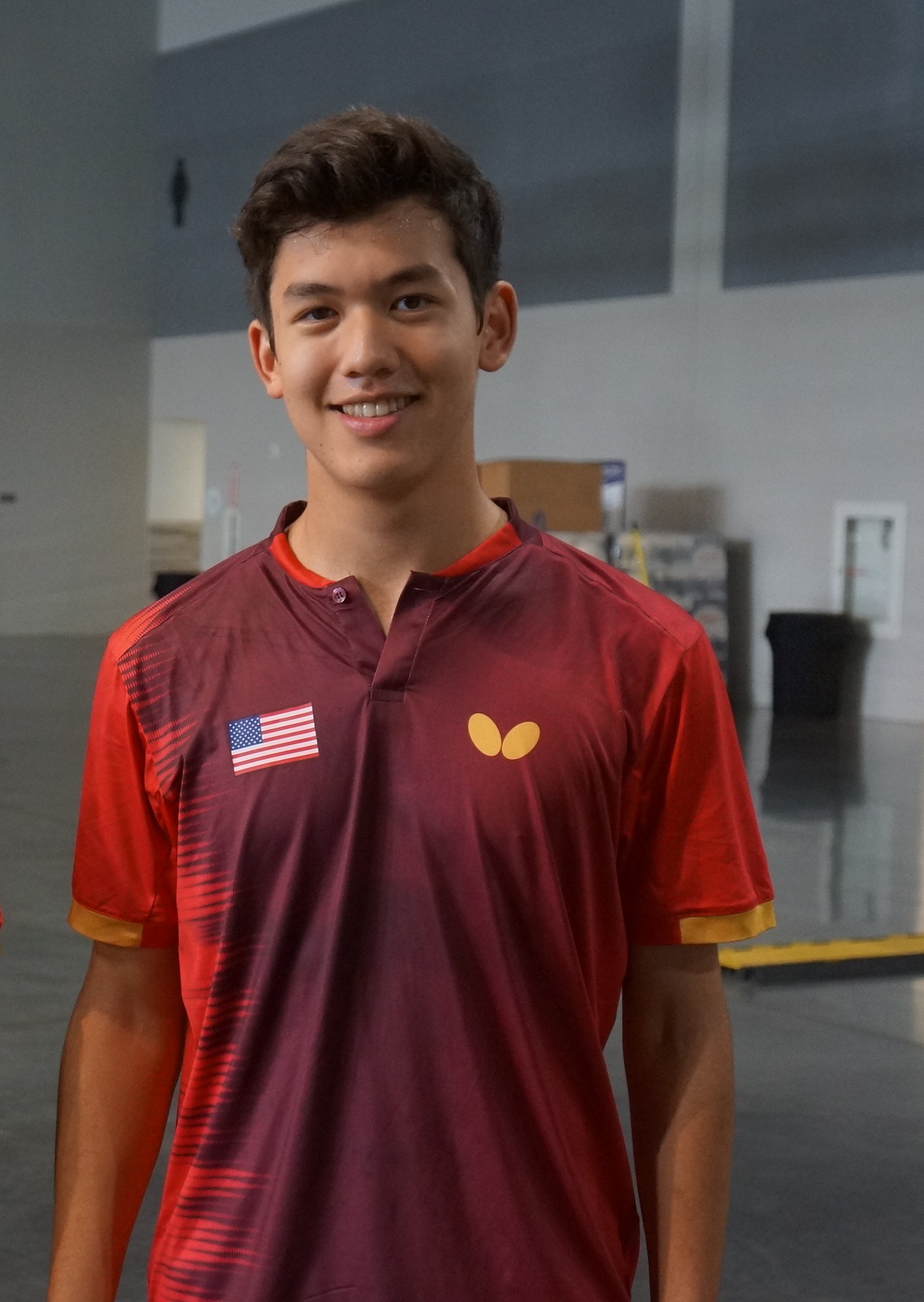
Bosman Botha (Photo by: Richard Ren/LAPost)
Speaking in Chinese, Botha introduced his multicultural family with a smile.
“My mother is Singaporean, and my father is South African,” he said.
He explained that growing up around Chinese language and Asian culture enabled him to communicate comfortably in Mandarin. He also said he has long followed the development of Chinese table tennis and hopes to have more opportunities to train and compete alongside Chinese players in the future.
Botha’s mother was also in attendance, cheering for her son throughout the match from the stands.
Many fans commented that the young American—with his international background, impressive physical presence, and fluent Mandarin—left a lasting impression and could become a familiar face on the international table tennis scene in the years ahead.
From Ping-Pong Diplomacy to China–U.S. Partnerships
This year marks the 55th anniversary of the historic U.S.–China Ping-Pong Diplomacy.
More than half a century later, two young Chinese players teamed up with American athletes on the WTT US Smash stage. Though they entered the tournament as wild cards and their runs ended in the opening round, their partnerships became one of the event’s most meaningful storylines.
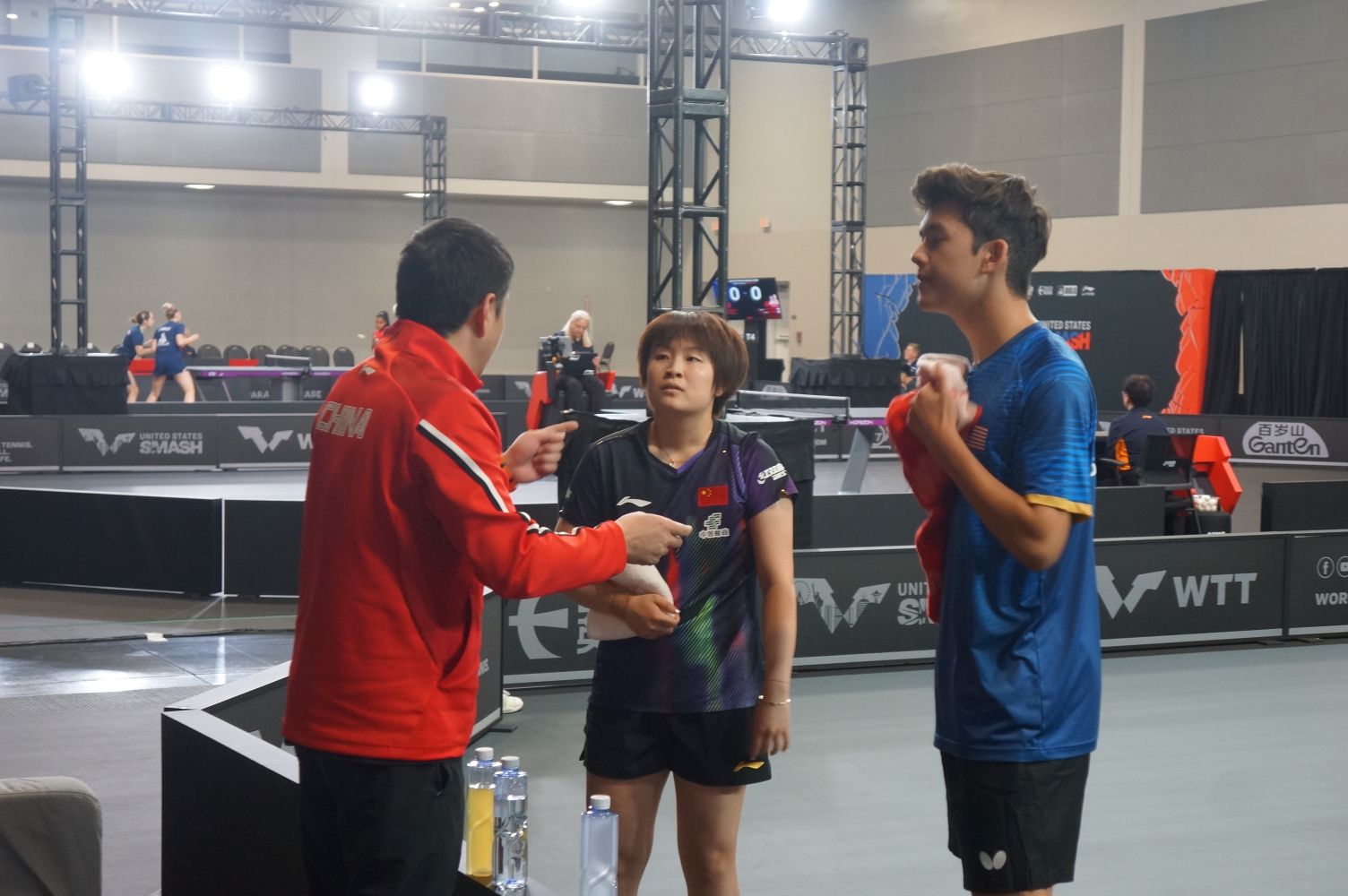
Bosman Botha and Qin Yuxuan receive coaching from the Chinese bench during their mixed doubles match. (Photo by Richard Ren/LAPost)
There are winners and losers in every match, but there are no losers when it comes to sportsmanship and friendship. From their teamwork on court and mutual encouragement after the matches to the applause they received from the crowd, the two China–U.S. partnerships demonstrated not only the appeal of elite table tennis but also the enduring role of the sport as a bridge connecting people across cultures.
As one spectator put it, “Matches have winners and losers, but friendship through table tennis never does. Moments like these are more memorable than any final score.”
(By Richard Ren/LAPost)