AI Meets Hollywood: Los Angeles Panel Explores the Next Chapter of Filmmaking and the Creator Economy
LAPost/Los Angeles, CA (September 12, 2026) — How will artificial intelligence reshape filmmaking? Will future directors still need traditional cameras? And as more people gain the ability to create film and video content with AI, how will creators build sustainable new business models?
Those questions were at the center of the “AI MODELS X HOLLYWOOD FILMMAKING” panel held Sept. 12 at City Club in Los Angeles.
Organized by AI-focused companies and creative technology partners including Alibaba Cloud, Retina Imageworks and WAN3.0 Creator Lab, the event brought AI models, Hollywood filmmaking and the creator economy into the same conversation. The panel was moderated by Hans, a young professional in the visual-effects industry, with Archie Prakash, Jonny Zeller and Mimi as featured speakers. The event drew filmmakers and other industry professionals, AI creators, content bloggers, students and young professionals.
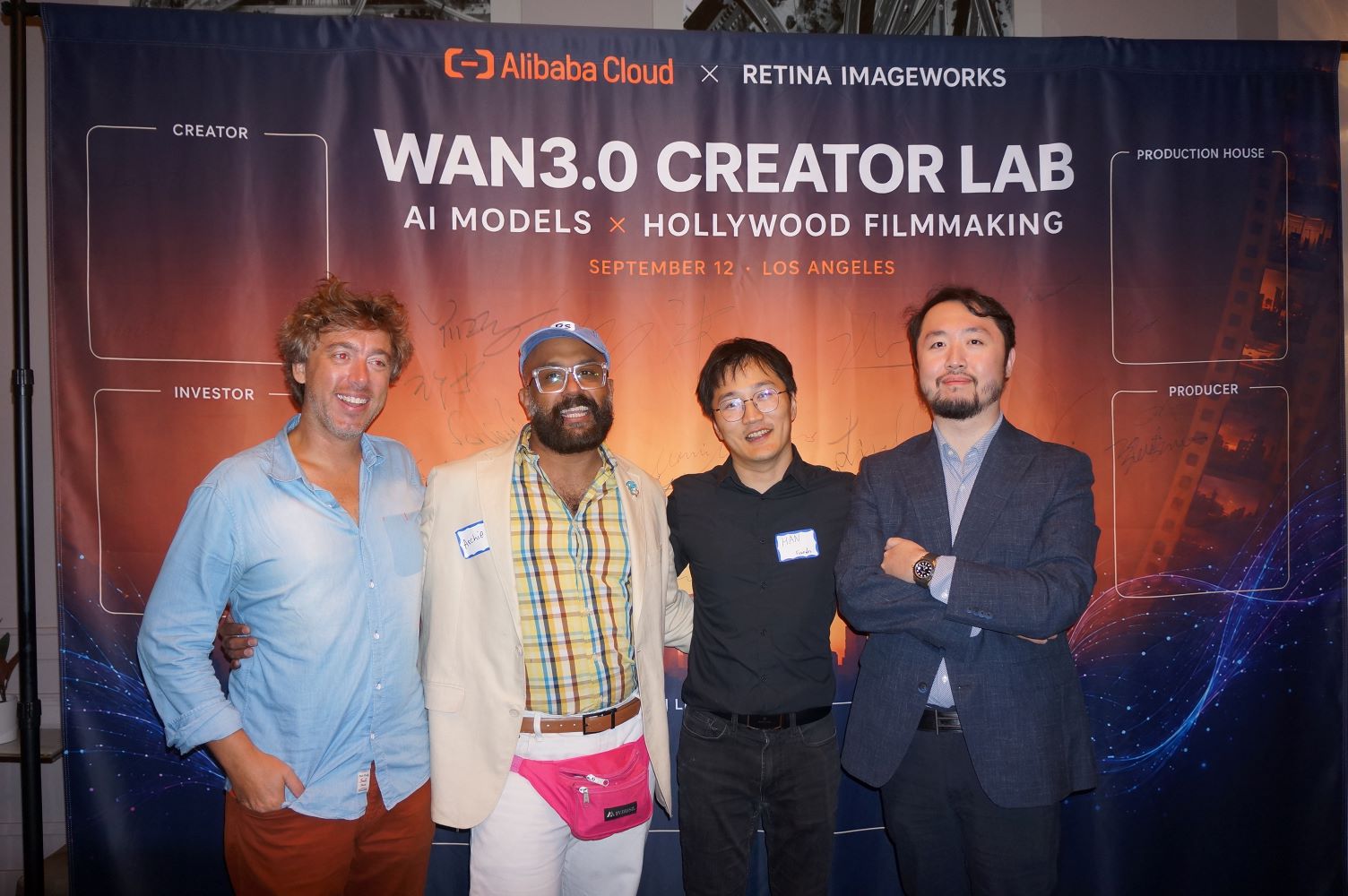
From Left: Jonny Zeller, Archie Prakash, Hans, Eric (Photo by: Richard Ren/LAPost)
Unlike events centered primarily on demonstrations of AI tools, the panel approached the subject from three complementary perspectives: AI-native creation, professional Hollywood production, and the business of content creation. Together, the discussions connected emerging technology to the practical realities of filmmaking, career development and monetization.
Archie: AI Is Changing Who Can Become a Filmmaker
Archie Prakash approached the discussion from the perspective of AI-native creation and the evolving internet content ecosystem. He shared his experience moving from animation and digital-content production into AI-driven creation, highlighting how AI can dramatically compress production processes that once took months.
Publicly available information describes Prakash as a creative technologist focused on AI and real-time technology. He has worked in areas associated with Technicolor, MSG Sphere and USC Cinematic Arts, and is currently Founder and CTO of Microdreams, an AI-native content studio focused on short-form production, including scripting, visual generation, production and distribution.
At the panel, Prakash also discussed the growing connection between AI-generated content and the internet culture of younger audiences. From memes and gaming to short-form video, younger users are already accustomed to rapidly changing visual formats, while AI gives individual creators the ability to experiment at a speed that was previously difficult to achieve.
Looking ahead, he suggested that AI’s impact could extend well beyond simply making conventional filmmaking faster. The industry could eventually move toward real-time generation, real-time television and even real-time filmmaking.
As AI systems become capable of generating imagery in increasingly short periods of time, entire productions could eventually move toward more immediate forms of creation and interaction.
The broader implication is significant: creative capabilities that were once available primarily to large studios are increasingly becoming accessible to individual creators and small teams.
Jonny Zeller: AI Is Entering the Filmmaking Pipeline, Not Simply Replacing It
If Prakash represents the emerging world of AI-native creation, director Jonny Zeller represents a bridge between traditional Hollywood production and new technology.
Zeller began his career in the camera department and editing before becoming a director. He has directed projects for brands including Google, Microsoft, Panasonic, Toyota and Adidas, while also working on film and long-form projects.
During the panel, Zeller did not frame AI simply as a way to replace a traditional film crew. Instead, he demonstrated how AI can be integrated with live-action production.
Examples discussed at the event combined real cars, actors and locations with AI generation, Blender, VFX and post-production compositing. In Mercedes-Benz-related creative work, for example, live-action production remained part of the process, while AI and visual effects helped expand visual environments that might otherwise have been difficult to achieve within a traditional budget.
Zeller also emphasized “multi-platform storytelling.”
In his view, a brand or entertainment project does not necessarily have to exist as a single finished film or commercial. A central story can extend across Instagram, YouTube and other platforms, creating a larger and more interconnected story world.
That means savings generated through AI do not necessarily have to translate into fewer people or less content. Instead, they can allow creators to develop more characters, more stories and larger worlds.
Zeller acknowledged that AI-assisted professional production still faces technical challenges, including issues involving compressed source material, generation quality, compositing and post-production. But the more important development, he argued, is that AI is already becoming another component of the traditional filmmaking pipeline.
Mimi: The Next Step for AI May Be Helping Creators Actually Make Money
Another major theme of the panel was the creator economy, with Mimi focusing on the business side of AI-generated content.
As AI lowers the barriers to producing video and other media, one increasingly practical question is emerging:
If everyone can create content, how do creators make money from it?
Mimi argued that future AI creator platforms should not stop at generation. They should connect creation, editing, publishing and monetization within the same ecosystem.
Creators could build their own channels and generate revenue through subscriptions, paywalled content or individual purchases.
She also discussed a more emerging concept involving personal likeness and intellectual property.
Under such a model, people who own their image, likeness or IP could authorize others to use those assets under controlled arrangements. Creators could then produce content using the authorized likeness, with revenue shared among the relevant parties.
That could create a new economic relationship extending beyond the traditional platform-creator-audience model, potentially connecting creators, likeness or IP holders and audiences in a new ecosystem.
Mimi also discussed the evolution of AI agents. In the future, creators may not need to master increasingly complicated prompting techniques. Instead, they could describe their creative intentions in natural language, with AI systems interpreting those instructions and carrying out much of the production process.
For young people seeking careers in the AI-content industry, that suggests opportunities may extend well beyond filmmaking itself—to AI platforms, content distribution, IP licensing, personal branding and creator monetization.
In the AI Era, Creativity May Become More Important, Not Less
Toward the end of the panel, the speakers were asked where AI could take the film industry over the next three years.
The discussion ultimately returned to a deceptively simple question: When everyone has access to similar AI tools, what will distinguish one creator from another?
The panelists suggested that AI could play a role similar to the digital camera in an earlier era, lowering production barriers and allowing more people to become creators. But once the technology becomes widely available, competition does not disappear. Instead, it may increasingly depend on a creator’s taste, judgment, storytelling ability and professional experience.
In other words, AI may make production easier without automatically making stories better.
That may be the most relevant takeaway for the young professionals who attended the event. Rather than presenting AI simply as a technology that will “replace Hollywood,” the panel brought together professionals from different backgrounds to examine how filmmakers can use AI, how AI-native creators can enter the entertainment industry, and how younger professionals can find opportunities within a rapidly changing production ecosystem.
In Los Angeles, a global center of filmmaking, the worlds of traditional production and AI technology are moving into increasingly close contact.
For the next generation entering film, advertising, VFX, gaming, digital media and AI entrepreneurship, that intersection may provide an important window into where the entertainment industry is headed next.
By Richard Ren / LAPost